PERÚ
Peru is an example at the international level, as it has a specific law for the protection of surf breaks, which was enacted by Congress in 2000 as a result of the efforts of the local community, and regulated in 2013.
Within the framework of the Breakers Law, Peru has 48 protected waves that are officially registered in the National Register of Breakers, administered by the Peruvian Navy. These areas prohibit the granting of rights to use aquatic areas and activites that may affect the surf break. However, the law does not regulate or restrict what can be done on land. Although there are laws that guarantee free access to beaches, in several cases such access has been restricted.
Although progress has been made in the development of integrated management plans for marine-coastal zones, these plans do not establish binding zoning, and land use planning at the level of coastal municipalities is still incipient.
At least four emblematic surf breaks are located within protected natural areas. For instance, at the Paracas National Reserve, where the San Gallán wave is located, the reserve's master plan includes a reference to the possibility of low-impact tourism activities such as surfing of San Gallán Island.

PERÚ
AUTOR: NOMBRE DE AUTOR
ACTUALIZADO: DD//MM/AAAA
1/
GENERAL RULES FOR THE PROTECTION OF SURF BREAKS
Peru is the first country in the world to have a specific legal framework for the protection of surf breaks: Law 27280, Law for the Preservation of Surf Breaks Appropriate for Sports Practice (2000), and its Regulations, from 2013, as well as the directives of the Peruvian Navy, which regulate the conditions for registering surf breaks in the National Registry of Breakers (RENARO). Currently, there are 47 waves registered in the RENARO.
1.1. HISTORY OF THE SURF BREAKS LAW
In the 1990s, Peruvian surfers organized themselves, raised their voices and achieved the enactment of the Surf Break Law. This happened after two of the most important waves in Peru were affected. The first case was La Herradura, a world-class wave in the middle of the Peruvian capital. To build a runway, a mayor ordered the dynamiting of the cliff and the coastal edge without any prior environmental study or planning. The result was disastrous: the beach, which attracted hundreds of visitors each summer day, eroded and filled with stones. The wave was never the same and the sand of one of the most beautiful beaches in Lima was lost. The second case is Cabo Blanco: in the 1990s, construction began on a fishing pier at Cabo Blanco, the historic fishing cove located in Talara, Piura, northern Peru.
After what happened in La Herradura, the surfers created the Asociación por la Conservación de las Playas y Olas del Perú (ACOPLO), an organization that filed an amparo action against the Ministry of Fisheries and the contractors for the construction of the pier and its impact on the breakwater. The amparo action, in this case, invokes the constitutional guarantee of the right of all Peruvians to live in a healthy and balanced environment, as well as the right to recreation and sports. The action was dismissed and declared inadmissible; however, it caught the attention of the authorities, which favored a negotiation with the fishermen and the Ministry of Fisheries. Thanks to this negotiation, it was agreed to change the position of the current dock. The wave was affected since its course was reduced, but without the intervention of the surfers, it would have ceased to exist.
As a result of this case, within the framework of conversations with the Navy to protect the waves, this institution requested the National Surfing Federation to send a list of the Peruvian surf breaks, from which to create a National Registry of Breakers. This idea was the basis of the Surf Break Law, which was promoted by then Congressman Jorge Trelles in coordination with the Board of Directors of the National Surfing Federation. There have been dozens of people who, over three generations, managed the approval of the Surf Break Law, its Regulations, and the technical standards that today have allowed, through the campaign HAZla por tu Ola, to raise funds for the preparation of the technical files required to enter the RENARO. The documentary A la Mar tells this story, which has involved thousands of people and dozens of companies in the same cause: the protection of Peru's waves.
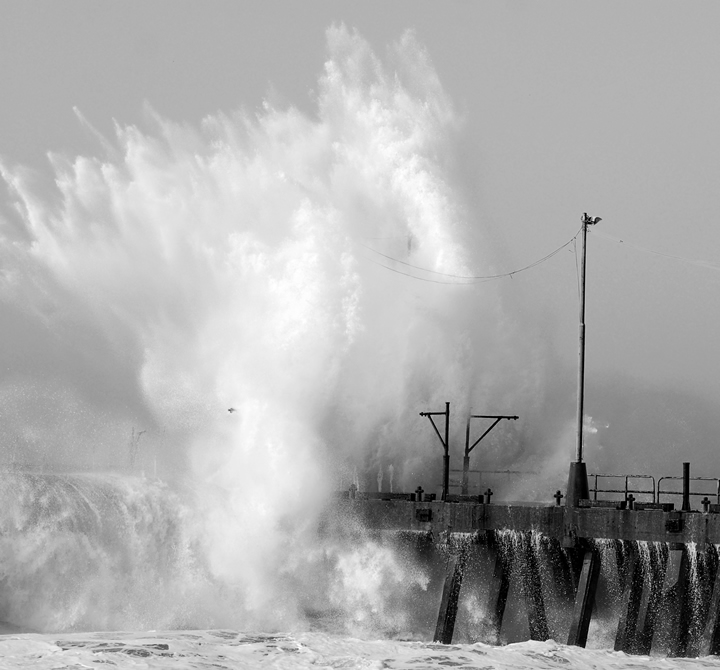
In Cabo Blanco, Perú, infrastructure located in the ocean cut in half the path of the high-quality wave. Photo: Goyo Barragán.
1.2. THE SURF BREAK LAW
The Law creates a National Registry of Breakers (RENARO) under the competence of the General Directorate of Captaincies and Ports (DICAPI) of the Peruvian Navy. The National Surfing Federation (FENTA), in coordination with the Peruvian Sports Institute (IPD), is in charge of making the list of waves to be protected, and formally requesting the DICAPI to register waves in the RENARO. For registration, the FENTA or the IPD must submit a request containing, among other data, the name of the wave, its location and coordinates, the scale of the plan, the plan of details, and the descriptive memorandum.
In addition to the Law and its Regulations, the Directorate of Hydrography and Navigation of the Peruvian Ministry of Defense issued Hydrographic Technical Standard 46, which is used to justify the existence of a wave. In other words, it requires the preparation of a file that determines the historical swell, direction, sizes and periods (based on bathymetry studies and other formulas) to technically determine the existence of a surf break and that said surf break is suitable for the surfing practices.
The specific process consists of the following stages:
Elaboration of the technical dossier by the companies authorized by DICAPI to carry out these studies.
Submission of the technical file by FENTA to DICAPI's Environment Directorate.
Observations made to the technical file by the Directorate of Hydrography and Navigation (DHN).
Addressing observations.
DICAPI’s visual inspection of the protection site.
Approval of the Director's Resolution by DICAPI, who registers the breaker in the RENARO.
Surf breaks registered in the RENARO are protected and, consequently, the DICAPI, which manages the registry of rights of use of aquatic areas, may not grant aquatic area usage rights or construction permits or others that affect or overlap with the area of the breakwater. In turn, projects that intend to develop, by exception, in the protected area of the breakwater must necessarily have an environmental impact study proving that the surf break will not be affected. In the event that such a project could affect the surf break, it must have been previously declared to be of national interest.
Waves that have not been registered in the RENARO do not have a specific level of legal protection and, therefore, their protection must be carried out with the general environmental standards, which are not effective for this purpose.
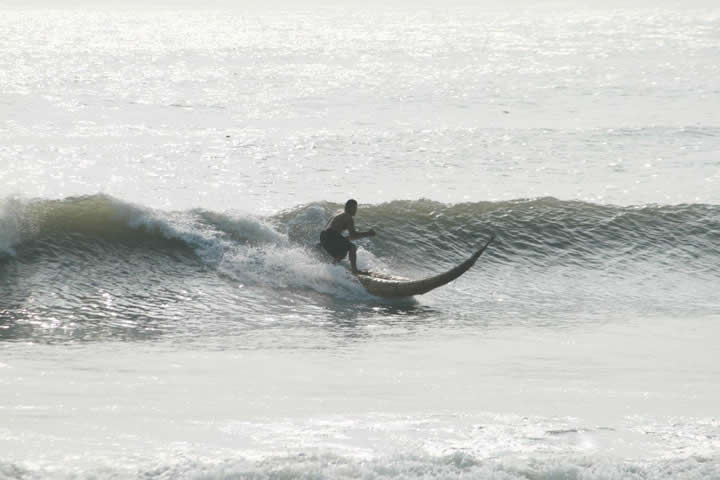
he Surf Break Law has been put into practice, for example, in Huanchaco, cradle of surfing in Peru: there, fishermen used (and continue to use) totora reed boats as the first means for riding waves. Near Huanchaco, the port of Salaverry was built, which has generated serious coastal erosion and has caused certain areas of beaches and coastal zones to disappear. To save the coastline, a project consisting of a series of breakwaters was proposed. Stakeholders were contacted, including the World Surfing Reserve Committee (located in Huanchaco) and the FENTA, who, using the Surf Break Law as support, managed to change the design of the project to avoid affecting the waves of Huanchaco. Photo: Carlos Antonio Ferrer.
2/
LIMITATIONS OF THE SURF BREAK LAW AND HOW TO STRENGTHEN IT
In spite of being an important model to protect surf breaks which, in addition, is inspiring similar law projects in other Latin American countries, the Surf Break Law can still be improved. Here we offer some suggestions to strengthen this law and thus increase the protection of surf breaks in Peru, which, of course, will also guide those seeking to replicate this model law in other countries.
First of all, the Peruvian law was designed to protect surf breaks considered suitable for surfing. The definition of a surf break offers flexibility by providing that it is where surfing can be practiced through various modalities. This is important because technology makes it possible today to surf in areas where it was impossible just a few years ago. Space must be left to include protections in order to maintain this dynamism.
The scope of protection provided by the law extends only to waves: “the area where the wave forms its curvature and falls, including the zone of wave formation, overturning and breaking from the beginning of its course to its termination." This definition does not include the physical components of the surf breaks that should be protected, such as the seafloor, the swell window, or the sedimentation processes on which wave forms depend. It is key to crucial to establish a broader legal definition of surf breaks that encompasses all their physical components.
Although there is a definition of an adjacent zone that was included to protect coastal dunes, which allows extending the protection of surf breaks to one kilometer of lateral coastline on both sides of the surf break, this scope is arbitrary and has not yet been implemented. The scope was defined because it was easier to establish later in time than the protection of the core zone of the surf break and its political feasibility. It is valid to reflect on whether there should be adjacent zones or not, and whether their establishment should be based on more detailed studies that justify a scope greater than one kilometer.
In addition, it is required to establish additional protections to ensure sediment flows. This is a challenge, because it is a highly dynamic process. Some options include establishing specific protections for nearby dune areas or requiring that infrastructure projects to prove they will not generate impacts on these flows. Another important challenge is to avoid damming rivers on which coastal sediment recharge depends.
Currently, there are no management plans for protected waves; monitoring their protection falls on civil society. The State should appoint agencies responsible for monitoring water quality in protected surf breaks, respecting public access, and the absence of threats to these surf breaks. It should also develop strategies that promote and enhance the value of the surf breaks, which would transcend the role of control and would allow to improve the infrastructure for public use.
Finally, the preparation of a technical dossier to protect surf breaks requires fundraising, another task that falls on non-profit organizations and citizen-led campaigns. This is because the law does not provide for such funding, nor does it require the Government to assume it. The costs of preparing files to document the existence of a wave, as required for registration in RENARO, range from approximately USD 1,000 to USD 5,200. Such costs vary depending on the physical conditions and environment of each wave. The amounts mentioned only show what is involved in the process of adding a wave to RENARO, without the additional financial and human costs: activists and organizations that devote time, energy and resources to wave protection advocacy, public awareness, and educational campaigns; and efforts to ensure the enforcement of the legal protection granted to RENARO-registered surf breaks.
The lack of funding to implement the Law of Surf Breaks is inversely proportional to the immense amount of revenue generated by the surfing and surf tourism industry in Peru, which contributes greatly to local economies throughout the country. Increased funding to protect surf breaks is essential to implement the Surf Break Law. The government could provide the technical capabilities of DICAPI or encourage the tourism sector and municipalities to hire specialists in order to develop technical dossiers for wave registration in RENARO.
If other countries seek to replicate the Surf Break Law, it is important that they consider from the outset the implementation of strategies to finance wave protection. Such legislation could allocate public funds, create matching fund programs, incorporate tools such as public-private partnerships or other innovative financing mechanisms.
3/
SURF BREAKS AND PROTECTED AREAS
The National System of Natural Areas Protected by the State (SINANPE) has nine categories of natural protected areas. Of these, national reserves, national parks, national sanctuaries, and landscape reserves are categories that could include, among their conservation objectives, the protection of surf breaks.
The San Gallán wave is located within the Paracas National Reserve. Although it is not part of the specific protection objectives of this reserve, this wave is indirectly protected. The master plan includes a reference to the possibility of low-impact tourism activities such as surfing in the area of the wave, without stepping on the island, to avoid damage to sea lion and bird populations. Additionally, in 2016, the zoning was changed to allow access to the surf break with private boats or tour operators that had the corresponding permits to take passengers to the island.
In the recently categorized Illescas National Reserve, there are also world-class waves, but in its master plan there are still no specific management measures to regulate tourism associated with surfing.
4/
SURF BREAKS IN MARINE-COASTAL ZONE MANAGEMENT PLANS
Although to date Peru has 47 surf breaks protected by law, this does not provide protection in terrestrial areas such as dune areas, nor does it prevent buildings that may alter the winds. Therefore, the application of the law should be complemented with other marine-coastal spatial planning processes (led by the Ministry of the Environment), or with the work of municipalities on zoning issues.
In 2015, the Guidelines for the Integrated Management of Marine-Coastal Zones were approved, among which is a registry of the activities and uses of marine-coastal zones (which includes, for example, surfing), and the need to value and respect the cultural and tourist values of such zones (which could include wave areas). In particular, the seventh strategic point of the guidelines describes the need to promote social participation in the management of the area, with the objective of increasing economic benefits through tourism. Such values include public beach access and recreational use, and surfing is an activity of national cultural and tourism importance, generating crucial income for coastal communities that can also support local marine conservation efforts.
Integrated management has also become a growing focus for the Peruvian government. The VII National Seminar on Integrated Marine-Coastal Zone Management in 2023 included presentations by government officials on progress in implementing the guidelines, as well as emerging considerations in marine-coastal conservation efforts, including the effects of climate change on the Peruvian coast and ocean. The Ministry of Environment has made progress in updating the objectives of the 2016 guidelines through the formation of technical groups to oversee such management and the development of regional action plans, e.g., in Ica and Piura.
5/
PUBLIC ACCESS
In Peru, it is a constitutional principle that everyone has the right to free transit throughout the national territory. In addition, Law 26856, called Law of Beaches, determines, in its article 1, that the beaches of the coast are public property, and that everyone has the right to access and enjoy these spaces. To this end, the same law provides, in its article 4, that in all projects adjacent to the beach and riparian land there must be, at least every 1000 meters, an access road that allows free access to the beach and sea area. Article 5 states that the municipalities are responsible for guaranteeing access, and that they should not authorize works that do not contemplate these roads.
However, in practice, this mandatory right of way to the beach zone is not adequately complied with. In many places, access is physically impossible due to barriers such as gates and walls. It is common in Peru to find beach condominiums owned by private owners, as well as clubs (including State entities such as the Navy) where access to citizens is restricted.
Some waves are also located within areas reserved for defense purposes or within areas franchised for port purposes and oil exploitation, which are difficult to access.
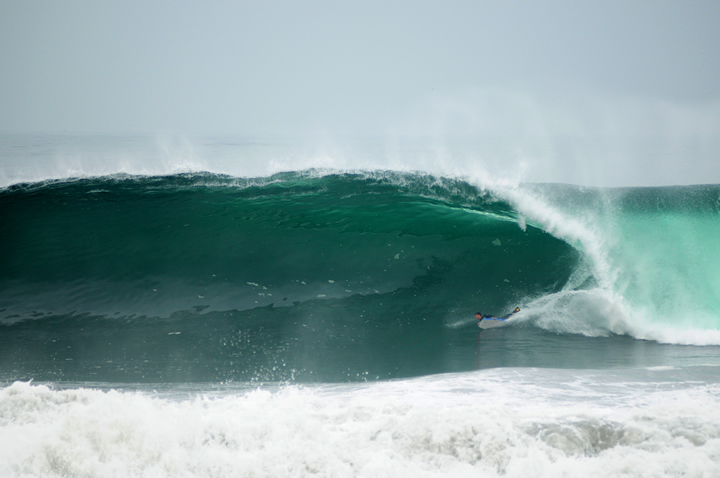
At Ñape Beach, in the district of Chilca, south of Lima, there is a high-quality wave located inside a Peruvian Air Force base. Some sportsmen have managed to obtain permits that allow them to access the beach through the base's facilities, but most of them must enter by walking or paddling through the sea, and they are constantly asked to leave the place. Photo: Carolina Butrich
6/
MARINE-COASTAL POLLUTION
Although the Surf Break Law provides for sanctions for those who pollute surf break areas, and also for dumping waste or solid waste in these areas, when cases of pollution occur, the environmental regulations linked to the sector causing the pollution (hydrocarbons, industries or others) are used. For example, at La Herradura beach, a complaint process was initiated against the district's mayor in order to have the clearing and waste removed.
Every summer in Peru, the General Directorate of Health monitors the quality of the beaches and publishes a public report so that the public knows which beaches are suitable for bathers. However, there is no entity specifically responsible for monitoring the quality of the beaches and waters of the protected surf breaks.